
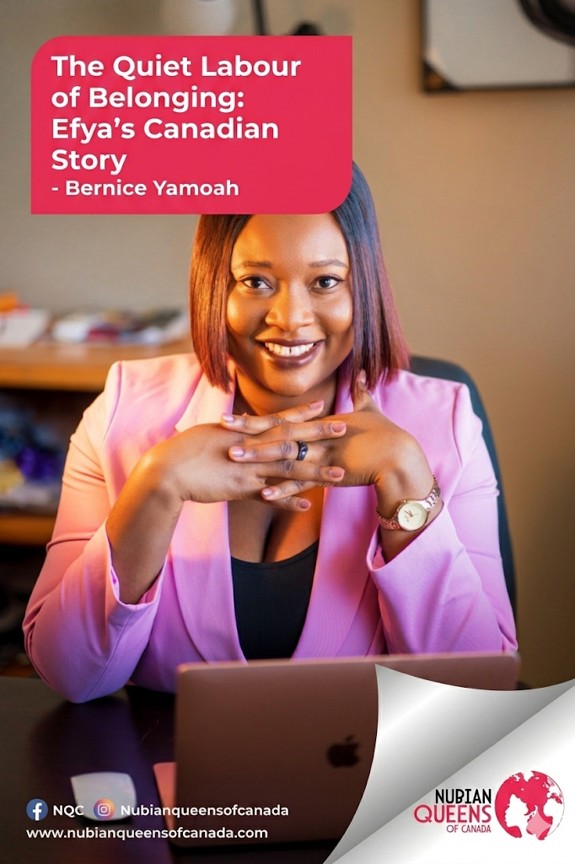

Bernice Yamoah, also known as Efya, is originally from Ghana and has been in Canada since February 2023. Having lived in four other countries, she is now based in Kingston, Ontario, which she now calls home. She is currently completing her doctoral studies at Queen’s University and believes that home is something you build, not something you find. Efya tells her full story here:
Before arriving in Canada, I had already done the work of starting over in three other countries, so I thought I was well versed in the art of migration, but Canada has surprised me in ways the others didn’t.
The cold, for one, was a shocker; also, adapting to the quiet of a smaller city after years of moving between European capitals and learning to navigate a new professional and academic system was another novelty for me. Still, the harder adjustments are the ones you don’t quite anticipate. So, I was the only Black woman in the spaces where I worked and schooled; this, in itself, was a challenge. Another thing was raising my family and a young child far from extended family; this is hard – especially when you have your family scattered around the world but then we connected with WhatsApp voice notes and the occasional flight home.
Another prominent challenge was having to constantly explain myself: where I come from, how to pronounce my name, and how I fitted in. Personally, what’s helped me through is something I learned over many borders: that home is something you build, not something you find. With this in mind, I’m happy to say that I’ve built mine here through community, through my work, and through being deliberate about choosing my network.
My doctoral research has been the most defining experience of my time in Canada. I’m a Doctoral candidate in Rehabilitation and Health Leadership at Queen’s university, and my dissertation, At the Margins, examines the structural and intersectional barriers immigrant men face when accessing mental health and addictions services in Kingston. It’s a community-engaged, narrative-based work, rooted in cultural safety and decolonial health frameworks.
So, why the interest? I took an interest in this research field because I kept noticing a gap – a male gap. Research shows that public conversations about immigrants and mental health often focus on women, which matters, but immigrant men, especially racialised men, are too often left out of the picture. The system is not designed to help men navigate the complexities of adapting to a new life in the diaspora, which prompted me to sit and listen to their stories – on their own terms.
What I didn’t expect was how much this work would change me. Sitting with men’s stories about pride, about silence, about the quiet labour of holding it all together has asked something of me that no other project ever has. I’ve had to confront my own assumptions about who needs help and what help even looks like. I’ve had to learn to listen without rushing to interpret, and to hold space for stories that don’t resolve neatly. Some days the work is heavy in ways that are hard to explain, but it’s also been the most meaningful thing I’ve ever done. I came into this research as a health economist, trained to trust numbers and models; now I’ll leave as a different kind of scholar, one who has learned that the questions I care about the most – questions about dignity, belonging, and survival- can’t be answered on a spreadsheet.
If given the chance to do this migration journey again, I will be kinder to myself. For the longest time, I thought adapting meant proving that I belonged in the room, proving that my accent, my pace, and my way of thinking added value rather than took up space. I worked twice as hard, said yes to almost everything, and didn’t always pause to ask whether the things I was chasing were the things I actually wanted. I’d also have asked for help sooner. This is because, as migrant women of colour, we often carry this quiet belief that we have to figure it all out alone, that asking for help somehow undoes us. It doesn’t. The most meaningful doors in my life have almost always been opened by someone else holding them – a mentor, a friend, a colleague, and a fellow scholar in a fellowship cohort. I most definitely would have leaned into the power of community earlier, and I’d worry less about looking like I had everything together.
My words of encouragement to women of colour in the diaspora are this: You belong here, and the story you carry is shaped by where you’ve been, the people who raised you, the languages and the silences you grew up with, and you should not shrink from these. It is what makes your work, your presence, and your perspective valuable.
Build community early. Find your people, the ones who understand without needing the full explanation. Protect your rest. Migration is its own kind of labour, and grief is part of it. Grief for the home you left, the version of yourself who lived there, the birthdays and funerals you miss. Let yourself feel that without rushing past it. Then ask for what you want. Send in applications – send that email, and take that seat at the table. Canada will not always make room for you on its own, but you, with all of who you are, are more than enough to make it.
Efya tells her story from Kingston, Ontario.